
Collapsible Rigid Box vs Setup Box: A B2B Buyer’s Decision Guide
A collapsible rigid box is worth considering when its approved construction can be assembled consistently and the confirmed packing form improves the complete supply plan. A setup box is often simpler when the pack must arrive ready to fill. Compare the physical samples, assembly work, shipping cartons and total delivered cost—not a product photo or unit price alone.
This guide helps a packaging buyer make that comparison without treating every hinged or folding-looking box as a confirmed flat-pack product. You can use its decision table, landed-cost worksheet, sample checklist and supplier brief to ask for evidence that is specific to your order. If a specification is not documented, mark it as open rather than turning an attractive photograph into a purchase assumption.
Start with the buying decision, not the name
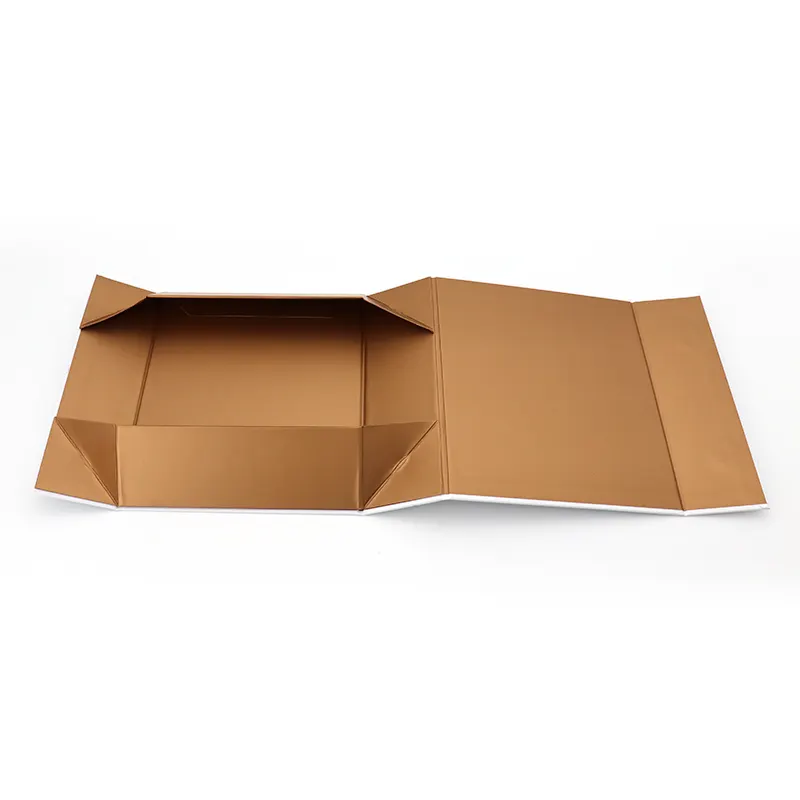
Suppliers may use “collapsible,” “foldable,” “book-style” and “rigid” for visibly similar presentations. Those words do not identify the same manufacturing route, packing form or assembly responsibility. Before comparing quotes, ask what arrives at your packing site, who makes the box usable, and which physical sample represents that supply form. A box that opens on a hinge is not automatically delivered flat. A box that has folding side walls is not automatically quick to assemble at scale.
The alternative is a setup rigid box: a formed, ready-to-use structure whose walls normally arrive assembled. It can remove a buyer-side assembly step, but the shipped and stored outer dimensions may differ from a confirmed flat-pack arrangement. Neither option is inherently cheaper, stronger or more sustainable for every project. Those outcomes depend on the actual construction, product, quantity, route and packing operation.
| Buyer decision | Ask for a collapsible construction when | Ask for a setup construction when |
|---|---|---|
| Receiving | Your team can verify the supplied form and assemble it under a documented instruction | You need boxes ready to fill on arrival |
| Warehouse | The confirmed packing configuration may help the available storage plan | Finished-box storage and handling are already workable |
| Presentation | The assembled sample meets the opening, alignment and surface requirements | A ready-formed structure better fits the required pack-out process |
| Quotation | The supplier can quote the box, packing form and any buyer-side assembly assumptions together | You can compare a delivered, ready-to-fill unit without an added assembly operation |
| Approval | A sample in the intended delivered form can be built and checked by the actual packing team | A finished sample represents what the packer will receive |
This table is a screening tool, not a performance specification. Write the chosen structure and delivery form into the RFQ and request a physical sample before making a bulk decision. The book and foldable box category shows visual references; an individual project still needs its own approved drawing and pack-out instructions.
What must “collapsible” mean in your quotation?
The word should describe a specified set of parts and actions. Does the outer cover arrive flat while an inner tray is already formed? Do side walls fold inward? Are corner tabs, adhesive areas or separate inserts involved? Does assembly happen at the factory, at a contract packer or at your own site? If two suppliers answer these questions differently, their “collapsible rigid box” quotes are not yet comparable.
Ask each supplier for three views: the delivered unit before assembly, the sequence needed to make it usable, and the finished box with the real product inside. Add a drawing or short physical-sample demonstration that identifies the hinge, walls, corners, closure and any removable components. Confirm whether the quoted unit includes an insert, sleeve, ribbon, magnet or protective packing material. Do not infer any of those items from a closed beauty shot.
Read a real photo without over-reading it
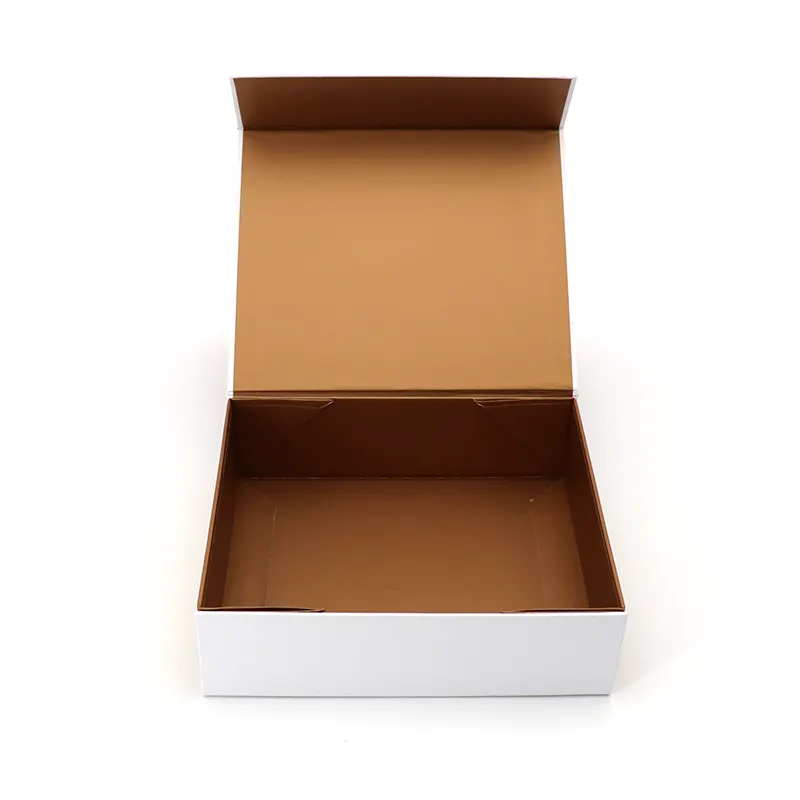
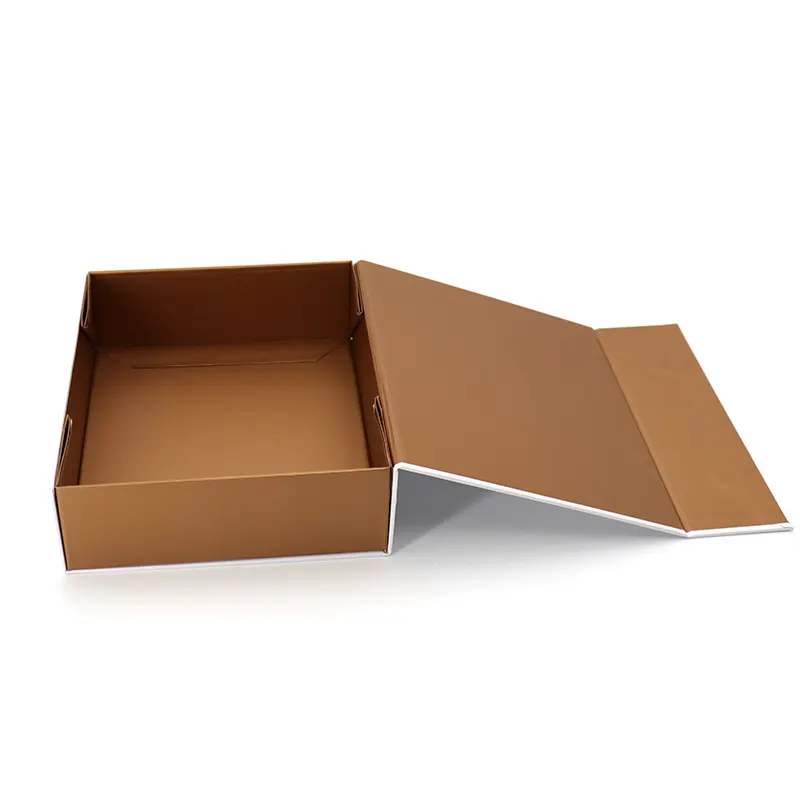
Our BXL-ZDH-003 product reference gives a useful example. The photographs show a white book-style exterior, a hinged cover, brown interior panels, a rectangular cavity and visible side walls and corner tabs when open. One open angle exposes a panel moving outward. Those are visible structural observations. The photographs do not establish board thickness, closure method, assembly time, the shipment configuration or freight savings.
This distinction matters because a buyer might see the open panel and assume every bulk unit is supplied flat. That could be wrong. A factory might supply the same-looking box partly assembled, fully assembled or in a different packing configuration agreed for the order. Until the factory confirms the intended configuration in a drawing, packing specification and physical sample, “ships flat” is a question, not a fact.
Compare the complete cost, not one unit price
A lower factory unit price can be offset by assembly labor, packing materials, storage, freight, rework or a different minimum order split. A higher unit price can still be workable if the delivered item is ready to fill and removes a genuine operational step. Equally, a confirmed flat-pack arrangement may improve one part of the route while increasing work at another point. There is no honest universal saving percentage without a project-specific comparison.
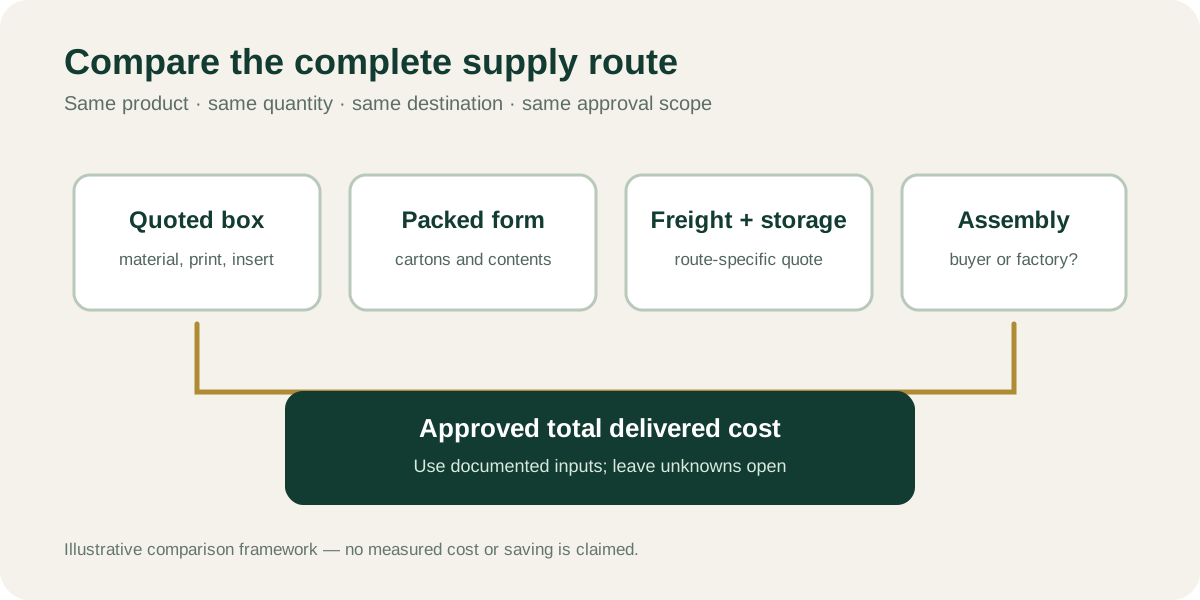
Build a total-cost sheet with the same quantity, destination, incoterm, packing standard and approval scope for both options. Ask suppliers to separate one-time tooling or sampling charges from recurring production charges. Request outer-carton dimensions and contents per carton for the exact quoted configuration; then obtain a freight quote for that configuration, rather than applying a rough saving figure taken from a different box.
| Cost or work item | Evidence to request | Who should confirm it? |
|---|---|---|
| Box unit price | Same dimensions, artwork, material direction, finish, insert and quantity | Packaging supplier |
| Packing configuration | Delivered form, units per carton, carton dimensions and gross weight | Supplier and freight partner |
| Receiving and storage | Space needed for the quoted cartons and any staged components | Buyer or packer |
| Assembly | Steps, labor owner, tools, fixture or adhesive requirements and rejection path | Packer using the physical sample |
| Product loading | Product orientation, insert fit, closure and protection method | Buyer, packer and supplier |
| Rework and disposal | How incorrect assemblies or damaged components are handled | Buyer and packer |
| Shipping and duties | Route-specific quotation based on the exact packed configuration | Freight partner and importer |
Record the assumptions next to each number. A spreadsheet full of prices with no matching packing form can create a false winner. If a supplier cannot yet confirm the outer carton, keep freight as “not quoted” rather than entering a guessed estimate. The OEM packaging process is the appropriate place to connect the structure brief to sampling and bulk approval; this guide is only the buyer’s comparison framework.
Check the receiving and assembly route
The first operational question is where assembly happens. A brand may fill boxes in its own warehouse; another may send components to a contract packer; a distributor may need finished units at a different site. The same structure can be manageable in one workflow and awkward in another. Ask the person who will actually build and fill the pack to handle the sample, not only the designer or purchasing team.
Walk the proposed unit through receiving, storage, opening the shipping carton, assembly, inserting the product, closing the box and repacking the finished item. Observe whether parts are easy to identify and orient. Check whether a wall can be assembled backwards, whether an adhesive or locking area is exposed at the wrong time, and whether the cover remains clean while the product is loaded. Document the sequence that works on the approved sample.
Protect the presentation experience
Both structures can look refined in a product photograph. The useful comparison is what the customer sees when opening the actual packed item. Does the cover sit square? Do edges align? Are the inner walls stable when a product is lifted out? Does a closure feel deliberate, and does the interior still look neat after the packing team has handled it? These are approval questions for a specific physical sample, not universal claims about one box family.
For a hinged book-style presentation, examine the opening angle, cover clearance and the point at which interior walls become visible. Put the real product or a representative weighted unit into the cavity. An empty box can hide interference between the lid, insert and product. If the product will be displayed at retail, packed inside a transit carton or opened repeatedly for a demonstration, tell the supplier which of these routes matters most.
Choose finishes only after the structure is understood. A wrapped edge, foil detail, printed panel or textured paper may be positioned near a fold or corner. Ask where the artwork crosses moving areas and whether handling can mark the surface. The materials and finishes page explains available finish directions, but the final appearance must be checked on a sample using the intended material and artwork.
Decide how the real product will fit
Start with the product, not the catalog dimensions of an empty box. Send its length, width, height and weight in the orientation in which it will be packed. Include protruding caps, cords, irregular edges or accessories. If several items share the pack, draw their relative positions and the order in which they will be placed and removed. Tell the supplier whether an insert is needed to hold the item, separate components or protect a printed surface.
Inside and outside dimensions have different jobs. Inside dimensions govern product and insert clearance; outside dimensions affect shelf presentation, master-carton planning and shipping. The box measurement and dieline guide shows how to label the dimensions you send. Do not compare two quoted boxes solely by outside width if one has thicker walls or a different cavity arrangement.
If a collapsible proposal uses folding walls or corner tabs, check whether their assembled position reduces usable space or interrupts an insert. Put the product into the assembled sample and close the cover. Then remove it as a customer would. Ask whether the packing operation changes the shape of the walls or shifts the item. The approved sample should represent the complete packed assembly, not an empty shell photographed from its best angle.
An insert decision is its own brief. Describe what must be held, displayed and removed; do not request a premium-sounding material without a retention reason. The custom inserts guide gives a separate framework for comparing fit, protection and presentation. If the insert is still undecided, mark both structure quotes provisional so a later insert does not invalidate the cost comparison.
Keep artwork and moving parts in the same review
A collapsible construction may place folds, overlaps or contact points where a flat artwork file looks uninterrupted. A setup box has its own wrapped edges and corner transitions. In either case, approve the structural dieline before treating printed artwork as final. Ask where the cut and crease lines sit, which panel is the primary display face, where the hinge bends, and which surfaces may rub during assembly or repeated opening.
Supply artwork in the required file format with linked images, fonts or outlined text as agreed with the supplier. Identify critical logo position, brand color reference and finish placement. Confirm whether a foil or embossing element crosses a bend or sits too near an edge. A screen render helps discussion, but a physical printed sample is the place to approve the visible result on the specified material.
The print-ready artwork guide covers the file handoff. A good-looking flat PDF is not evidence that a finished box closes, aligns and packs correctly.
Use one sample to test the whole route
A sample should answer the questions that would otherwise become costly after bulk release. Ask for the construction that the supplier actually proposes to produce, with the intended delivered form clearly labelled. If the first sample is a structural mock-up without final material or print, record that limitation. Do not sign it as approval of surface finish or color. If a later printed sample changes board, wrapping or assembly, repeat the fit and closure check.
Run the sample through the real packing sequence. Use the actual item when practical, or label any substitute and its differences. Assemble the box according to the supplier’s instruction, add the product and insert, close it, open it, and inspect the corners and inner surfaces. If a test is required by the buyer or destination market, agree the method, acceptance criterion and responsible party separately; a photograph cannot stand in for a test report.
| Sample checkpoint | What the buyer should record | What a photo alone cannot confirm |
|---|---|---|
| Delivered form | Which components arrive, how they are packed and who assembles them | Bulk packing configuration |
| Wall assembly | Sequence, corner-tab position, alignment and any tools or adhesive | Repeatability for your operators |
| Product fit | Packed orientation, clearance, insert retention and removal path | Fit of an unseen real product |
| Cover and closure | Hinge movement, closing clearance and any confirmed closure component | Closure method hidden inside the structure |
| Appearance | Surface, artwork placement, edge wrapping and visible marks | Final color or finish from a screen image |
| Record | Drawing revision, sample identifier, agreed changes and sign-off owner | What will be reproduced in bulk without a written approval |
Keep the physical sample or a controlled reference for comparison. Review the quality-control process for how sample approval relates to prepress, production and final packing checks.
Make two supplier quotations genuinely comparable
Send the same request package to each supplier. It should state product dimensions and weight, estimated quantity by size and artwork version, intended display and delivery route, preferred structure, material and finish direction, destination and the person who will assemble and fill the box. Add reference photos as a starting point, not as the only specification. Ask for any missing information before expecting a firm quotation.
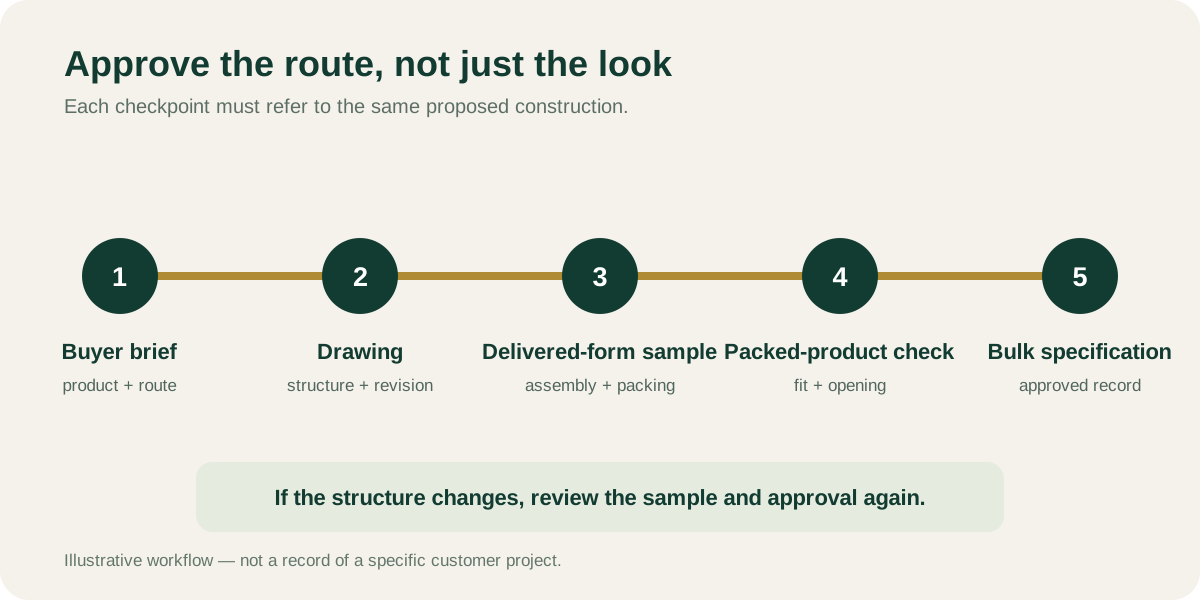
Request each supplier to identify its proposed construction in words and a drawing. The quote should tell you whether the box is supplied flat, partly assembled or ready to fill; which components are included; how units are protected in the shipping carton; and which sample or tooling charges are separate. If a change in board, insert or artwork would create another setup, ask how the quotation treats that change. Do not assume that two offers using the same product category name include the same scope.
Freeze the bulk specification after the choice
The purchasing decision is not complete when someone chooses an attractive sample. Freeze the structural drawing and revision, finished and inside dimensions, material and finish, printed artwork version, insert or accessory, supplied form, assembly instruction, packing configuration, inspection checkpoints and destination details. Identify who can approve a change and what requires another sample. This record keeps a later production run tied to the structure the buyer evaluated.
If a supplier proposes a substitute material or a different way to fold a wall, ask what changes in the finished dimensions, appearance, assembly and packing form. A variation that looks minor on paper can affect product fit or the buyer’s receiving operation. Review the proposed change against the approved sample before release. Record any unresolved point instead of letting an email phrase such as “same as previous” hide a different construction.
A buyer brief you can send today
Fill in what you know and ask the supplier to mark missing details as pending technical review. Attach product photos and dimensions if a physical item cannot be sent initially.
- Identify the product, packed orientation, measured dimensions, weight and every accessory that must fit inside.
- State the use: retail display, gifting, direct-to-consumer fulfillment, distributor handling or another defined route.
- Say whether the box must arrive ready to fill or whether a named team can assemble it; ask the supplier to confirm the proposed supply form.
- Provide target inside size if known, desired opening direction, any insert requirement and a reference image such as BXL-ZDH-003.
- List the desired paper, print, finish, color reference and artwork files as preferences until a sample confirms them.
- Give quantity by size and design, shipping destination, packing site and required approval or delivery milestone without assuming a lead time.
- Request a structural drawing, delivered-form sample, assembly instruction, carton-packing specification and a quote with scope exclusions.
- Ask how changes to fit, artwork, material or packing form will be reviewed before bulk production.
Send the brief to the supplier and packer. Resolve any disagreement on a sample. For our factory, use the project inquiry page with the reference code, product and destination.
The practical decision: choose the lowest-risk approved route
Choose a collapsible rigid box when the delivered form is confirmed, the actual packer can assemble the approved sample reliably, the product fits and the full delivered-cost comparison supports that route. Choose a setup rigid box when a ready-to-fill structure is more compatible with the packing operation or when the purported flat-pack benefit remains unverified. A folding carton may be a third option if the required presentation and product protection can be met by that different construction; it should be evaluated as a separate sample, not relabelled as a rigid box.
Avoid two mistakes: assuming a photographed folding wall proves flat delivery, and choosing the lowest unit quote without counting assembly and logistics. Keep unknowns visible and decide from matching specifications.
Frequently asked questions
Is every book-style box with a hinged cover a collapsible rigid box?
No. A hinge and an opening panel show how the box presents, not how bulk units are supplied. Ask for the delivered-form drawing, packing specification and physical sample before using “collapsible” in the purchase order.
Does BXL-ZDH-003 definitely ship flat?
The current photographs do not establish that. They show a hinged cover, brown interior walls and visible corner tabs; the factory must confirm the proposed bulk packing and assembly form for your specific project.
Which option is cheaper, collapsible or setup?
There is no project-independent answer. Compare matching specifications and include box price, sample or tooling charges, packing configuration, freight, storage, assembly work and potential rework before deciding.
What is the main risk if my team assembles the boxes?
The main practical risk is approving a visually attractive sample without testing the actual assembly sequence and packed-product fit with the people who will do the work. Use the intended packer and document the approved instruction.
Can I approve the box from a rendering or photographs?
Photos can support a structure discussion but cannot establish board thickness, closure, delivered form, product fit, repeated assembly behavior or shipping performance. Approve a physical sample and any separately required test evidence.
What dimensions should I send first?
Send the product dimensions and weight, its packed orientation and any accessories or insert needs. Label desired box dimensions as inside or outside and ask the supplier to confirm the finished drawing before sampling.
Should I ask for a flat-pack quotation and a ready-to-fill quotation?
Yes, if both supply forms are feasible for your product. Ask the supplier to describe what is included in each, and compare delivered cost and buyer-side work using the same order and destination assumptions.
How do I compare two supplier offers using different structure names?
Ask each supplier for the drawing, supplied form, included components, carton-packing specification, assembly instruction and a physical sample. Compare those records and the completed pack, not only the category label.
When should the material and finish be finalized?
After the structure and product fit are clear, approve the specified paper, print and finish on a representative sample. If the material or finish changes the fold, wrap or visible result, review the assembled sample again before bulk release.
What must be frozen before bulk production?
Freeze the drawing revision, dimensions, product fit, material, artwork, finish, included components, supplied form, assembly instruction, packing configuration, inspection points and approved physical sample; identify who authorizes later changes.