
What Is Chipboard? A Buyer's Guide to Greyboard in Rigid Gift Boxes
Chipboard is a dense, non-corrugated board made mainly from recycled paper fibers, and in packaging it is the hidden core of almost every rigid gift box. Box factories in China usually call it greyboard. Its thickness, not its printed surface, decides whether a lid feels solid, whether corners hold their shape, and where two quotes for the "same" box quietly differ.
This guide explains what chipboard is, how it differs from paperboard and corrugated board, how to choose a thickness for your product, and what to check before you approve bulk production. It is written for brand owners, importers and sourcing teams who buy custom rigid boxes and want to compare quotations on the same terms. The ranges below are common industry starting points, not promises; the right board for your box is confirmed on a physical sample.
What chipboard is, and why rigid box factories call it greyboard
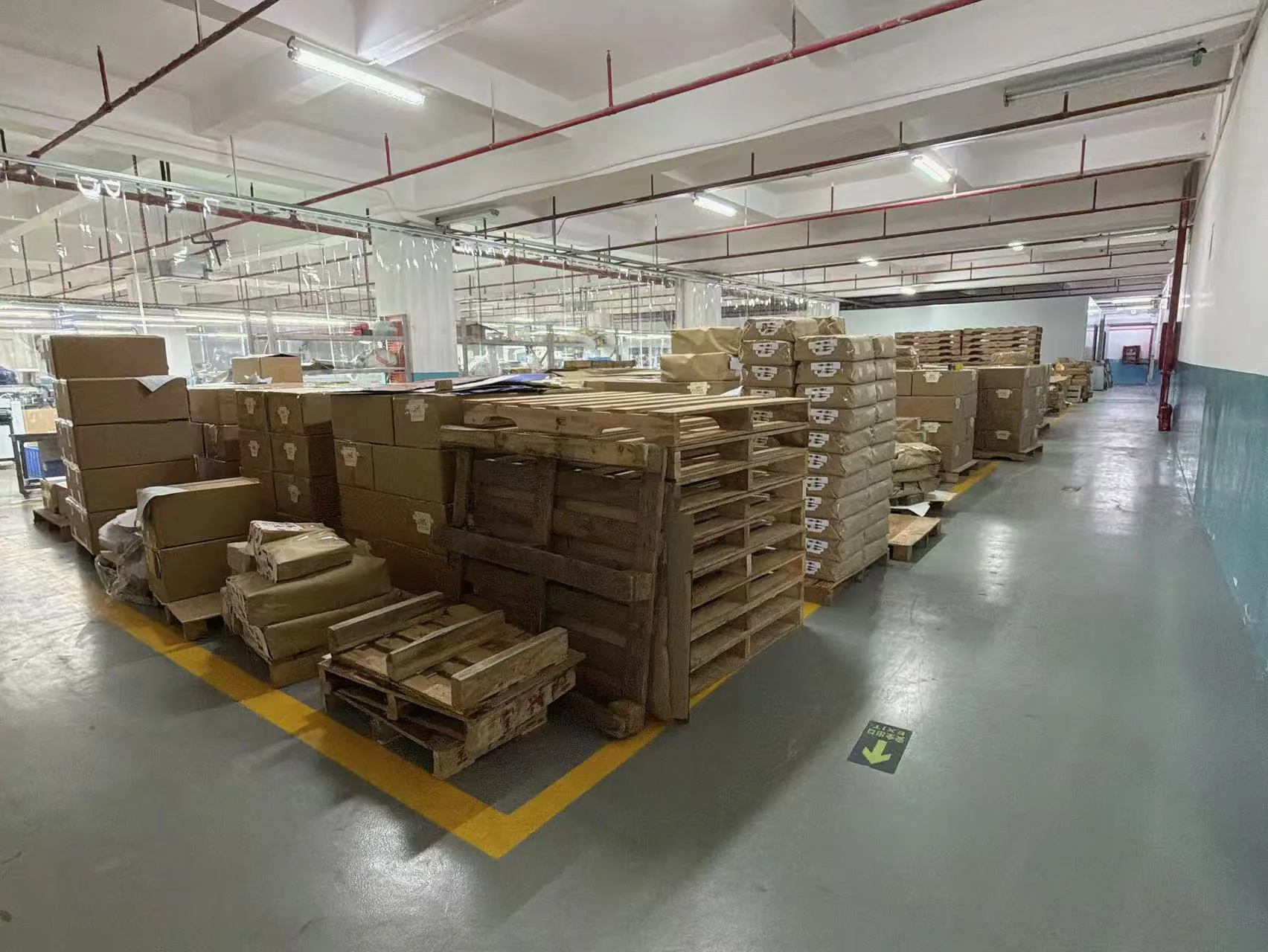
Chipboard is made by pressing layers of recycled paper pulp into a stiff sheet. Because the fibers come from mixed recovered paper, the sheet is usually grey or dull brown on both sides, and it has no fluted middle layer. That solid, uniform structure is what makes it useful for rigid boxes: it can be cut cleanly, grooved and folded into walls that keep their shape, then covered completely with a printed or specialty wrap paper.
The same material appears under several names. In the United States, buyers and converters often say chipboard. In China, Europe and many factory specifications, the same board is called greyboard, grey board or rigid board, and in US catalogs you will also see gray chipboard. Some suppliers also write binder board or book board, because the same kind of dense board is used for hardcover book covers. When you read a quotation, these words normally describe the same core material; what matters is the stated thickness and the grade.
One warning matters if your team works across markets. In British English, "chipboard" usually means particleboard, the wood-chip panel used in furniture. That is a completely different material. If a UK colleague says a gift box is made of chipboard, check that everyone means paper-based greyboard and not wood. In your purchase documents, writing "greyboard (paper-based chipboard), 2.0 mm" removes the ambiguity.
Chipboard is also different from white-lined chipboard and duplex board. Those boards have a coated white top layer so they can be printed directly, and they are common in folding cartons. Rigid box greyboard is not printed; it is wrapped. The printing, color and finish you see on a rigid gift box live on the wrap paper, while the greyboard underneath provides the structure.
Chipboard vs paperboard vs corrugated: what each does in a gift box
Buyers often ask whether they should choose chipboard, paperboard or corrugated board, as if one were simply better. Each board solves a different packaging job, and many projects use more than one. A rigid gift box may have a greyboard shell, a paperboard insert and a corrugated shipping carton around it.
| Board | Structure | Typical role in a packaging project | Main buyer trade-off |
|---|---|---|---|
| Chipboard / greyboard | Solid, dense, non-corrugated recycled-fiber board, usually 1.0–3.0 mm or more | The core of rigid boxes: lid and base boxes, magnetic flip boxes, drawer boxes, book-style boxes | Premium feel and shape retention, but heavier and costlier to ship than folding cartons |
| Paperboard (folding boxboard, SBS, white-lined chipboard) | Thinner single sheet, often with a white printable surface | Folding cartons, sleeves, simple inserts and retail packs that ship flat | Light and economical, but it does not give the same solid feel as a wrapped rigid box |
| Corrugated board | Liners with a fluted middle layer | Mailer boxes, shipping cartons and protective outer packing | Strong for its weight and good at absorbing impact, but the surface and edges look less refined |
If your product will be presented on a shelf or opened as a gift, a wrapped greyboard structure is usually the starting point. Compare our lid and base gift boxes, magnetic flip boxes and book-style and foldable boxes to see how the same core board becomes different structures. If the box mainly has to survive parcel shipping, start with corrugated mailer boxes. If you need a light retail pack that ships flat, look at folding cartons.
The choice is not always either-or. A common route is a greyboard rigid box for presentation, packed inside a corrugated carton for export. When you ask for a quote, list every layer you expect so each supplier prices the same packing system.
How to choose chipboard thickness by box size and product weight
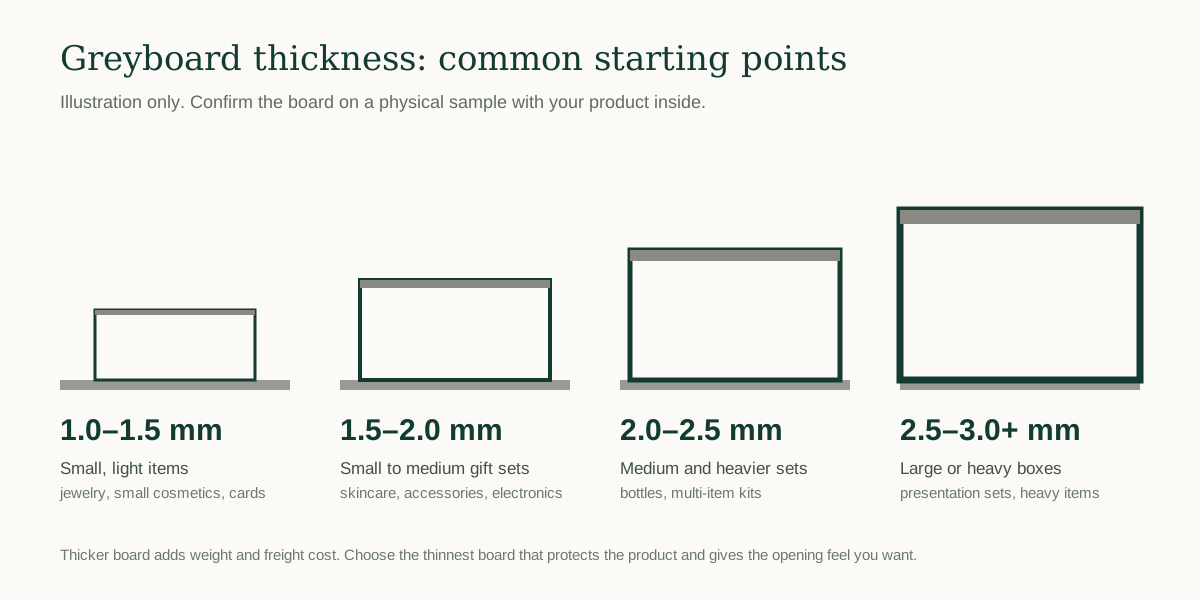
Rigid box greyboard is specified by caliper, meaning thickness, rather than by weight. Supplier guides and mill references differ on exact figures, but most rigid boxes use board between about 1.0 mm and 3.0 mm, with some large or heavy presentation boxes going thicker. The table below collects common starting points used across the industry. Treat it as a way to start the conversation, then confirm the board with a physical sample of your own product.
| Box type and contents | Common greyboard starting point | What to check on the sample |
|---|---|---|
| Small, light items: jewelry, small cosmetics, cards | 1.0–1.5 mm | Lid feel, corner sharpness, whether the base flexes when lifted |
| Small to medium gift sets: skincare, accessories, small electronics | 1.5–2.0 mm | Wall stiffness with the product inside, lid fit after repeated opening |
| Medium boxes and heavier sets: bottles, multi-item kits | 2.0–2.5 mm | Base sag under load, corner crush during stacking |
| Large or heavy presentation boxes | 2.5–3.0 mm or more | Overall weight, carton count per pallet, shipping cost |
Three factors move you up or down this table. The first is box size: a large lid needs thicker board to stay flat even if the product is light. The second is product weight and how it is held: a heavy item resting on a thin base will make the base bow, while a well-designed insert can spread the load. The third is how the box travels and is stored. Boxes that are stacked in tall cartons, shipped through humid routes or handled many times need more margin than boxes that go straight from a carton to a display.
A thicker board is not automatically better. Each step up adds weight, which raises freight and can change how many boxes fit in an export carton. It can also change the feel of a magnetic closure or the way a lid slides onto a base. The aim is the thinnest board that keeps your product safe and still gives the opening experience your brand wants, proven on a sample rather than chosen from a list.
You may also see chipboard described in points, a US unit for caliper. One point equals 0.001 inch, or about 0.0254 mm. The conversions below help when a US designer and a Chinese factory are reading the same specification.
| Points (pt) | Approximate thickness |
|---|---|
| 24 pt | 0.61 mm |
| 30 pt | 0.76 mm |
| 40 pt | 1.02 mm |
| 50 pt | 1.27 mm |
| 60 pt | 1.52 mm |
| 80 pt | 2.03 mm |
| 100 pt | 2.54 mm |
Sheets in the 20–30 point range are thin chipboard, closer to a cereal box than to a rigid gift box. Rigid box cores are normally specified in millimeters, so write the thickness in mm on your purchase documents and ask the supplier to confirm it in the quotation. You can also ask for the board's grammage (GSM), but do not convert GSM to thickness with a single fixed number; density varies by mill and grade, so the same GSM can produce different calipers.
Why a thinner board makes a cheaper quote, and what it costs you later
When two factories quote the same rigid box at very different prices, the board is one of the first places to look. Greyboard is a large share of the material in a rigid box, and dropping from 2.0 mm to 1.5 mm, or from one board grade to a lower one, can lower the price noticeably while the photo and the drawing look identical. The problem usually shows up later, after the order has shipped.
A board that is too thin or too soft tends to fail in predictable ways. Lids bow in the middle, so they no longer sit flat on the base. Corners crush in the export carton, and the wrap paper creases where the board has given way. Magnetic flip lids stop closing cleanly because the panel has warped. Heavy products make the base sag when a customer lifts the box. None of these problems is visible in a rendering, and some are not visible until boxes have been stacked or shipped.
Board is not the only place where two quotes can differ. Use this list to see what each price actually includes before you compare totals:
| Cost element | What can change between two quotes | What to ask |
|---|---|---|
| Greyboard | Thickness, grade and density | "Which board thickness and grade is quoted, in mm?" |
| Wrap paper | Paper type and weight, specialty paper vs coated art paper | "Which wrap paper is quoted, and what weight?" |
| Printing | Number of colors, Pantone vs CMYK, coverage | "How many colors, and is any Pantone or spot color included?" |
| Surface finish | Lamination type, foil, embossing, spot UV | "Which finishes are included, and on which panels?" |
| Insert | Material and construction (paperboard, EVA, foam, plastic tray) | "What insert is quoted, and is it fitted to my product sample?" |
| Closures and extras | Magnets, ribbon, handle, window film | "How many magnets, and are ribbons or handles included?" |
| Packing | Inner bags, carton strength, units per carton | "How are boxes packed for export, and how many per carton?" |
A quote that does not state these items is not wrong, but it is not comparable. Ask each supplier to fill the same list, then compare line by line. A slightly higher price with a clearly stated 2.0 mm board and the finishes you need is often the cheaper choice once remakes, damage and delays are counted.
How chipboard becomes a rigid gift box in our factory
A rigid gift box is a combination of two separate products: a printed wrap and a greyboard shell. Knowing how they come together helps you understand what to specify and where problems can start. At Baoxinglong, rigid gift boxes are made on a dedicated floor of our Shenzhen building, while printing happens on the first floor.
The wrap paper is printed first. We print packaging on two Heidelberg Speedmaster presses, a CX105-5 and a CX75-5, both five-color with inline coating, and color is measured with X-Rite instruments against the approved proof. Finishes such as lamination, foil stamping, embossing and spot UV are added to the printed sheets before they are cut.
The greyboard is cut to the panel sizes in the structural drawing. For a lid and base box, each part is formed from board and then wrapped: glue is applied to the printed wrap, the board is placed on it, and the wrap is folded over the edges and turned into the inside. We run two automatic and two semi-automatic rigid box machines for lid and base production, and a hand-finishing team handles the steps machines cannot, such as wrapping complex shapes, fitting inserts and adding ribbons. On average, our rigid box floor produces about 20,000 rigid gift boxes a day.
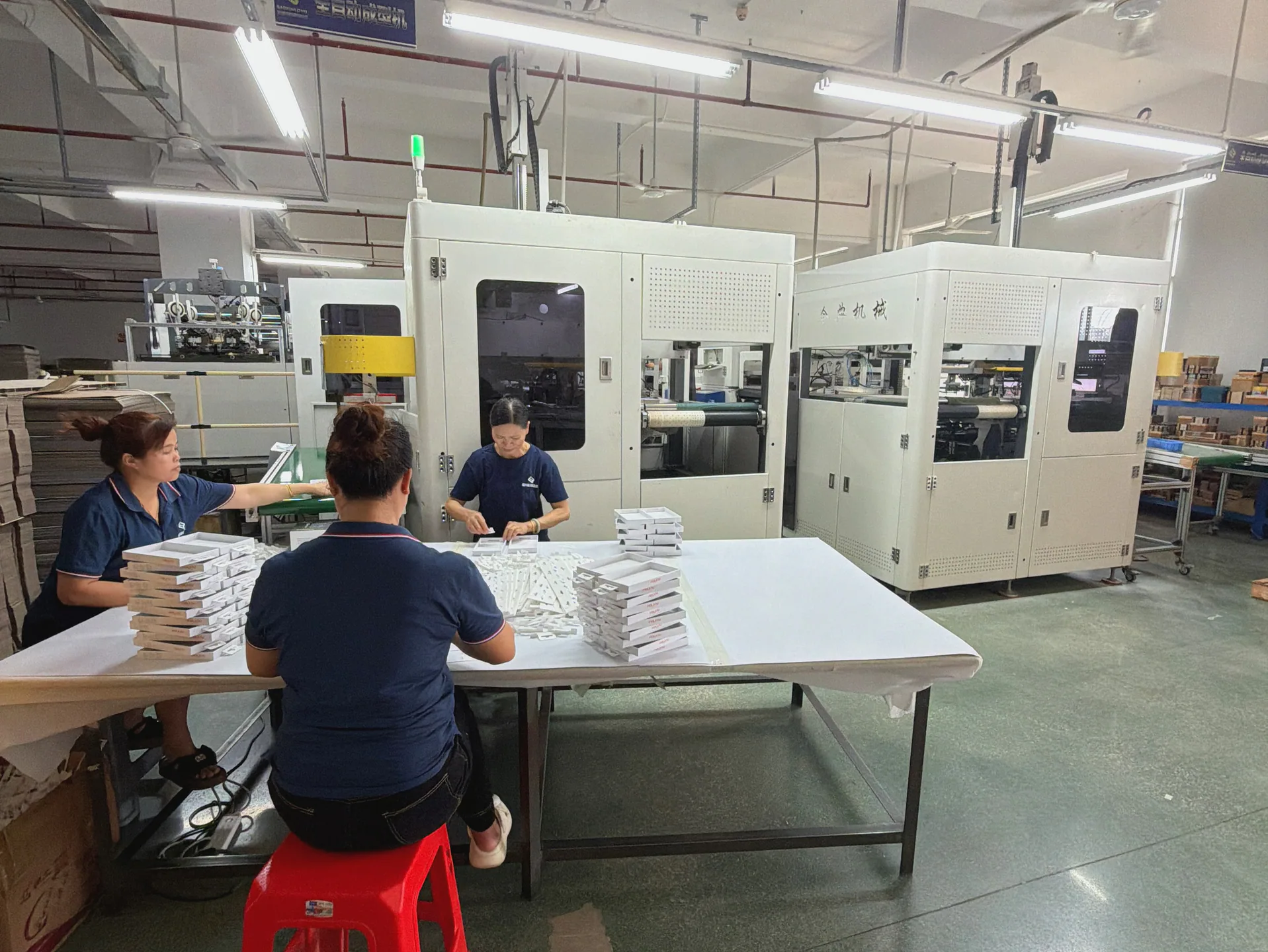
Before boxes are packed, printed sheets and finished pieces pass through checks. A Daheng automatic inspection machine looks for color variation, missing content, specks, and faults in UV or foil. Quality inspectors check gluing and assembly for glue overflow and firm bonding, and confirm packing against the agreed instructions. You can see more of the floor on our factory tour and the full list of checkpoints on our quality control page.
Two things follow from this process for a buyer. First, the board and the wrap are separate decisions: you can change the paper or finish without changing the structure, and vice versa, but each change should be approved on a sample. Second, the glue and the wrap paper must suit the board. A heavy specialty paper on a thin board, or a wrap that shrinks as it dries, can pull the board out of shape. That is why the sample should be made with the same board, paper and finish as the bulk order.
Warping, bubbling and peeling: moisture and glue problems to test for
Most complaints about rigid boxes are not about the board breaking. They are about the box changing shape or the wrap coming loose after it leaves the factory. Greyboard is made from paper fibers, so it reacts to moisture. Glue reacts to temperature. Both matter for boxes that travel by sea, sit in warehouses or move between climates.
Warping is the most common symptom. If the wrap paper and the board absorb or lose moisture at different rates, the panel bends, usually toward the side with the wrap. Lids that warp no longer sit evenly on the base, and magnetic flip lids may not close. Bubbling and wrinkles appear when glue is unevenly applied or the paper moves before the glue sets. Peeling at corners and edges often comes from glue that loses strength in heat or becomes brittle in cold.
You can reduce these risks with a few practical steps:
- Ask the supplier which glue system is used for wrapping and whether it has been tested at high and low temperatures. At Baoxinglong, we use a high and low temperature tester to check glue performance on boxes, because boxes can sit in a hot container and then in a cold warehouse.
- Keep the same board and paper combination from sample to bulk. A change of wrap paper weight or type can change how the panel behaves.
- Let samples rest for a few days before final approval, then check flatness, corners and closures again. Some warping only appears after the glue has fully cured and the board has settled.
- Agree on packing that protects shape: inner bags or wraps where humidity is a concern, enough carton strength for the stack height, and a sensible number of units per carton.
- If your boxes will be stored for long periods or shipped through very humid routes, mention this in your RFQ so the board and packing can be chosen with that in mind.
Our materials and finishes page explains how wrap papers and finishes are matched to the board. If you are choosing an insert at the same time, read our guide to custom box inserts, because the insert also affects how much load the base carries.
Recycled chipboard and FSC claims: what you can and cannot say
Greyboard is usually made with a high share of recycled fiber, which is one reason brands like it. Recycled content varies by mill and grade, though, and supplier figures are often marketing estimates rather than a standard. If recycled content matters for your packaging claims, ask for the specific board's recycled-content information in writing rather than relying on a general statement.
FSC claims need more care. An FSC claim on packaging is only valid when the supplier holds a current FSC Chain of Custody certificate, the material is purchased through an eligible FSC route, and the order and invoice state the FSC claim. A factory holding a certificate does not make every box it produces FSC-certified.
Shenzhen Baoxinglong Printing and Packaging Co., Ltd. holds FSC Chain of Custody certificate DCI-COC-001757, valid until October 27, 2031. Its scope covers product types including cardboard packaging, corrugated paper packaging and paper bags, with FSC Mix and FSC Recycled claims. You can check the certificate code on the FSC public database at info.fsc.org. If you need an FSC claim on your rigid boxes, say so in the RFQ, so the board and paper are sourced on an eligible route and the claim, label and documents are agreed before printing. Our FSC certificate page explains the steps.
Avoid general claims such as "eco-friendly box" or "100% recyclable" unless you can support them for your specific materials and markets. Laminations, foils, magnets and plastic inserts can all affect how a box is sorted for recycling. If a claim matters, write it into the specification and confirm it with documents.
What to put in your RFQ so quotes are comparable
The fastest way to get useful, comparable quotations is to give every supplier the same brief. You do not need a perfect technical file to start. You need enough detail that each factory is pricing the same box.
| RFQ item | What to send | Why it matters |
|---|---|---|
| Product | Size, weight, number of items, and a photo or sample | Board thickness and insert design depend on what goes inside |
| Box structure | Lid and base, magnetic flip, drawer, book-style, or a reference photo | Each structure uses board and labor differently |
| Inside dimensions | Length × width × height of the space the product needs | Prevents boxes that are too tight or too loose |
| Board | Preferred greyboard thickness in mm, or "please recommend" | Makes quotes comparable on the biggest material cost |
| Wrap and printing | Paper type, colors, Pantone references, artwork status | Changes the price and the color approval route |
| Finishes | Lamination, foil, embossing, spot UV, and on which panels | Finishes add cost and process steps |
| Insert and extras | Insert material, magnets, ribbon, handle, window | Often left out of quick quotes |
| Quantity and timing | Quantity per design, target delivery date, destination | Affects planning, packing and freight |
| Claims and documents | FSC or other requirements, testing, inspection plans | Must be agreed before materials are bought |
If you do not know which board to choose, ask the supplier to recommend one and to state it in the quote, then ask a second supplier to quote the same board. Our standard working MOQ is 1,000 pieces per size and design, and we draw the dieline for your box free of charge. The custom packaging MOQ, sampling and lead time guide explains how quantity and timing are planned, and our guide to measuring a box helps you send the right inside dimensions.
What to check on the sample before you approve bulk
A physical sample is where the board choice is proven. A rendering can show color and shape, but only a sample shows how the board feels, how the lid fits and whether the box holds your product securely. Samples usually take 3–5 working days once dimensions, materials, artwork and finish are confirmed, and digital samples are free.
When the sample arrives, check it with the real product inside:
- Lift the box by the base with the product inside. The base should not bow or sag.
- Press gently on the center of the lid and on each corner. The panels should feel solid and spring back.
- Open and close the lid many times. A lid and base should slide on smoothly without rubbing through the wrap; a magnetic lid should close cleanly and stay closed.
- Look along each panel against the light to check flatness. Check again after the sample has rested for a few days.
- Inspect corners and edges for creases, gaps, glue marks and lifting paper.
- Check that the insert holds the product without forcing it, and that the product can be removed easily.
- Compare color and finish with the approved proof under consistent light.
- Pack a few samples in the intended export carton and check them after handling, if transit damage is a concern.
Write down what you approve: the board thickness, wrap paper, finishes, insert, closure and packing. Bulk production usually takes about 15 days after the sample and artwork are approved, and the exact date is confirmed in the quotation. Approving against a written specification, not only against the sample in your hand, is what keeps the bulk order the same as the box you tested. If you are still deciding between a box that ships flat and one that arrives formed, our guide to collapsible rigid boxes vs setup boxes walks through that decision.
Frequently asked questions
What is chipboard used for?
In packaging, chipboard is used as the core of rigid boxes such as lid and base gift boxes, magnetic flip boxes, drawer boxes and book-style boxes, and in thinner grades for backing cards, dividers and simple inserts. Outside packaging, the word can also mean wood particleboard for furniture, which is a different material.
What does 50 point chipboard mean?
Point is a US unit for board thickness: one point is 0.001 inch. A 50 point chipboard is about 1.27 mm thick, which suits light rigid boxes or inserts. Most rigid gift boxes use thicker greyboard, so state the thickness in millimeters on your quotation.
What is chipboard made of?
Chipboard is made mainly from recycled paper fibers that are pressed into a dense, solid sheet without a fluted layer. In packaging it is usually grey or brown and is used as the core of rigid boxes, then wrapped in printed paper.
Is chipboard the same as greyboard?
In packaging, yes. Chipboard, greyboard, grey board and rigid board usually describe the same dense recycled-fiber board used in rigid boxes. In British English, however, chipboard can mean wood particleboard, so state "paper-based greyboard" and the thickness in mm on your documents.
What thickness of chipboard is used for rigid gift boxes?
Most rigid gift boxes use greyboard between about 1.0 mm and 3.0 mm. Small, light boxes often start around 1.0–1.5 mm, medium gift sets around 1.5–2.5 mm, and large or heavy boxes 2.5–3.0 mm or more. The right thickness is confirmed on a sample with your product inside.
Is chipboard stronger than corrugated board?
They are strong in different ways. Corrugated board is better at absorbing impact for its weight, which is why it is used for shipping. Chipboard is denser and holds a crisp shape, which is why it is used for presentation boxes. Many rigid boxes are shipped inside corrugated cartons.
Why do two quotes for the same rigid box differ so much?
The most common reasons are different board thickness or grade, wrap paper, finishes, inserts, closures and packing. Ask each supplier to state these items in the quote, in the same format, before comparing prices.
Why do rigid boxes warp, and how can I prevent it?
Warping usually happens when the board and wrap paper absorb or lose moisture at different rates, or when glue does not suit the conditions. Keep the same board and paper from sample to bulk, ask about glue testing at high and low temperatures, let samples rest before approval, and agree protective packing.
Can chipboard rigid boxes carry an FSC claim?
Yes, when the supplier holds a valid FSC Chain of Custody certificate, the board and paper are bought through an eligible FSC route, and the claim is agreed on the order and invoice. Baoxinglong holds FSC certificate DCI-COC-001757; tell us in your RFQ if you need an FSC claim.